Category: blog

  • Gone birding

    A friend texted me after seeing some of my Instagram posts recounting the birds I’ve spotted:

    “You’ve officially reached old man status!”

    A new notion? Perhaps!

    A new notion swiftly calls for new gear.

    I was inspired, oddly enough, by The Residence on Netflix. Specifically the main character, Cordelia Cupp, a world-famous consulting detective called in to investigate the death of the chief usher at the White House. Much like her literary and cinematic forebears — Sherlock Holmes, Hercule Poirot, and Benoit Blanc — Cordelia exudes a quiet confidence, unintimidated by the powerful, and solves mysteries through keen originality and sharp analysis.

    On some level, I think my interest in birding has more to do with my aspiration to be like her: highly observant, with a razor-sharp memory for detail; patient; and the smartest person in the room. These are qualities I hope to cultivate in myself. And while watching birds obviously isn’t going to transform me into a genius detective overnight, I believe the practice offers lessons that can inch me closer to those ideals. Graaakkkllle!
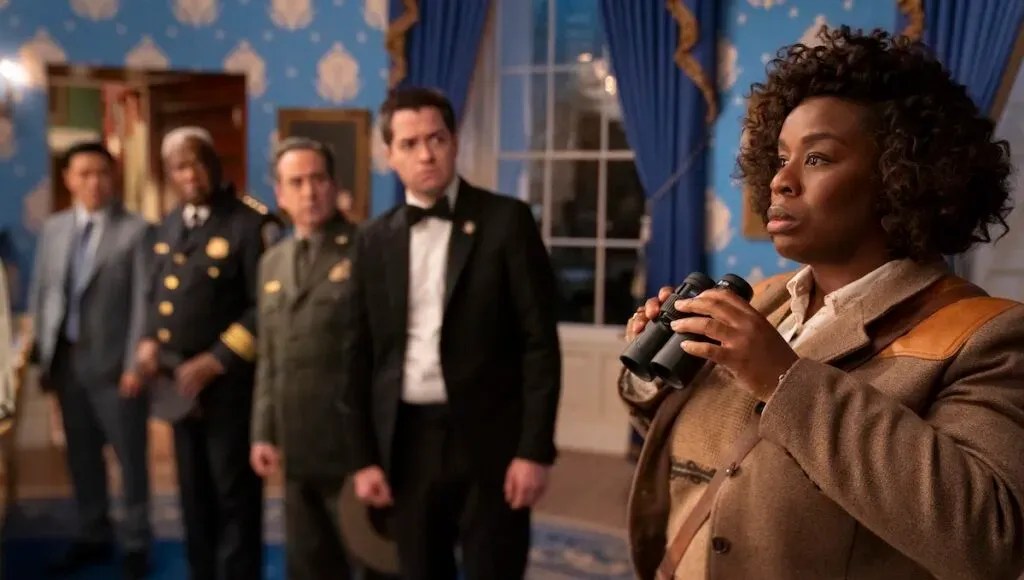
    That’s a ZEISS Victory SF 8×42 and it costs over €2,500 🥵

    Truth be told, I’ve never been much of an animal person. Looking at animals, interacting with them, rarely stirred anything in me. Except for the occasional cat or dog, though even then I’m extremely picky. Cats and dogs often trigger my allergies, and while I know that doesn’t mean all animals will, I’ve been conditioned to approach most creatures with caution.

    So colour me surprised when I found myself genuinely enjoying watching birds, learning their names, admiring the intricate details of their feathers and movements. Somehow I had forgotten that real life could be so breathtaking. I’m convinced our HD-4K screen-addled brains have warped our sense of wonder. I mean, why go out of your way to experience the real thing when you can stay comfortably at home, consuming it all on demand?
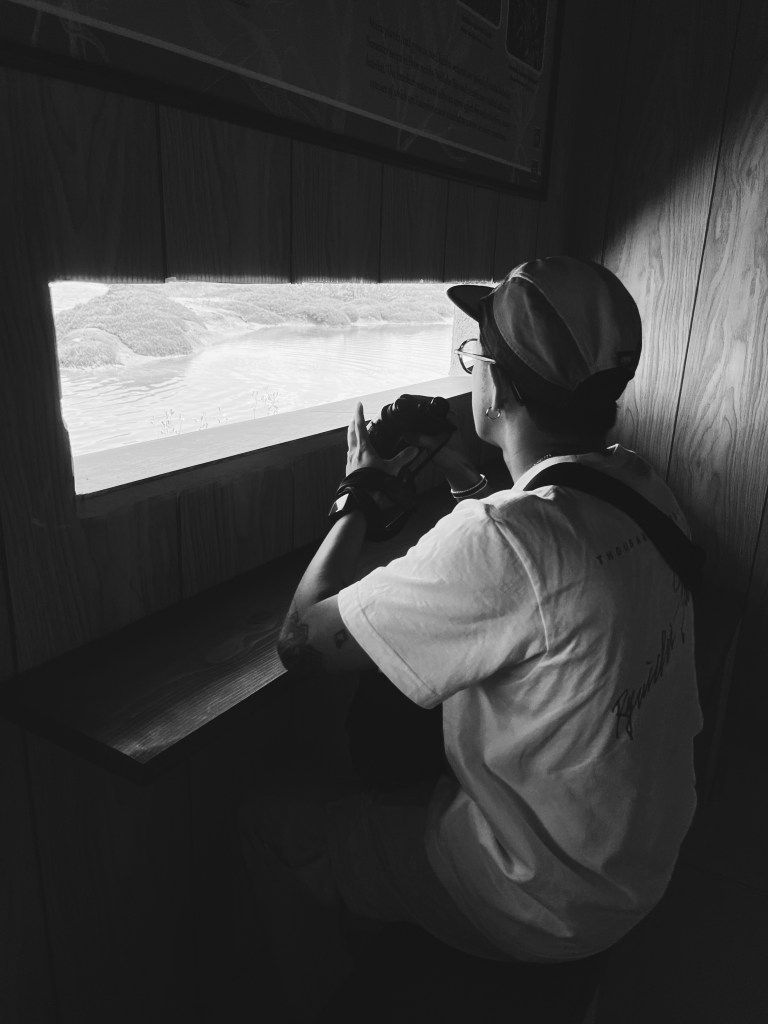
    Me in a bird hide @ Ghadira Nature Reserve.

    Because watching common swifts dart across the sky, or great crested grebes diving and resurfacing in a quiet river, or cormorants drying their wings on a perch: these moments slow time. They slow me. I’ve always found it difficult to relax, but birding softens my anxieties, steadies my breath, grounds my feet. Birding is healing! It is medicine, a cure-all for those affected by hyper-capitalist afflictions.

    Another aspect I find surprisingly enjoyable is the little thrill of ‘catching’ a new species. It’s a bit like Pokémon hunting: try to spot as many different kinds as possible, then log what you find. I’ve been using a free app called Merlin ID—probably the most wholesome app on my phone. No ads, no dopamine traps. A rare platform that isn’t trying to extract anything from me. Existing purely out of love for bird observation.
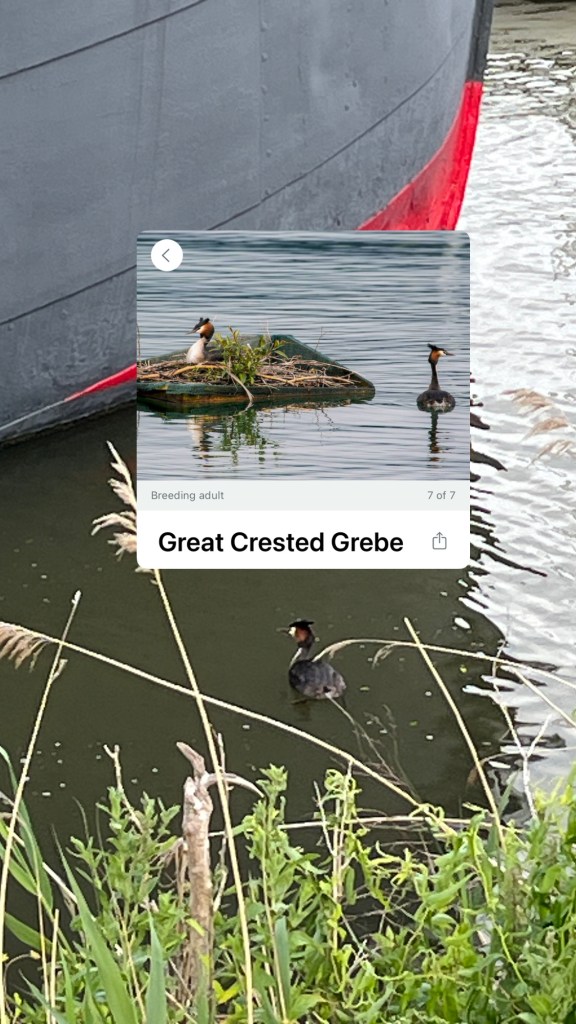
    Merlin’s Sound ID listens to the birds around you and shows real-time suggestions for who’s singing.

    It’s so easy to forget that we live on a planet with unfiltered beauty right before our eyes and that the natural world is always there, waiting to be witnessed. All we have to do is pay attention.

    Birds! What a gift. Their songs and calls (even the startling squawk of a heron) are a kind of grace. Logging them feels like a small act of gratitude. A way of saying, Thank you. I see you.

    “You’ve officially reached old man status!”

    At 34, I wear this as a badge of honour. But what is it about birds that speaks so universally to people as they grow older? Is it the freedom they represent? No cholesterol, no rent, no tax deadlines to dread? Or simply the everyday miracle of their existence, made more poignant by an awareness of mortality?

    Whatever it is, I’m in deep.
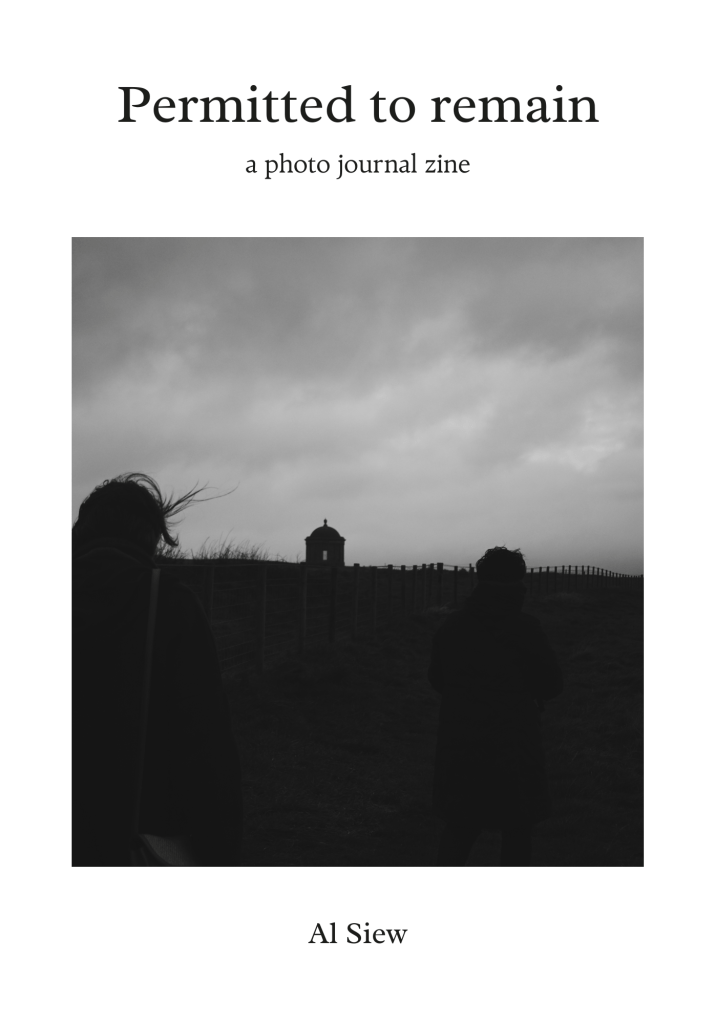
  • Permitted to remain

    Permitted to remain is a photo journal zine chronicling my attempt at migrating to Ireland. I was granted three years to stay, but left after three months, unable to navigate the challenges of unaffordable housing and inaccessible healthcare. This zine is a document of that time in my life.

    The photos were mostly taken in County Donegal, where we spent most of our time. The excerpts (edited by Nine) are drawn from my blog, repurposed to give voice to this compilation. 

    Reader’s tip: Pair with dark by 4:30—a playlist I put together while battling the frustrations of migration and the cold, short, gloomy days in Ireland. 


    The digital version is now available for viewing here.

    The physical edition will be available for purchase in early 2025, with all profits going to Garabtaag, a collective of volunteers assisting refugees in Malaysia. Your support for this project will be channelled directly to refugees for housing, healthcare, and basic living expenses.

    Reach out to me directly if you want to reserve one: hello.alsiew@gmail.com

    Thank you for viewing!

  • YukiMomo

    I’ve been helping my neighbour feed her cats and water her one (1) plant while she’s away. 

    Neighbour as in she lives just two doors away from our building and one time when we had big scary insect problems in our apartment, we called her for help.  She didn’t come to our rescue but did offer her cats because and I quote “Momo is good hunter”. 

    Neighbour as in some times when I hear loud noises coming from upstairs, I text her to ask if she could hear it too. Neighbour as in when there’s leftover beer from entertaining guests, she offers it to me because she doesn’t drink. Neighbour as in when there’s a power cut, we ask if she wanted to have dinner somewhere together while we wait for the lights to come back on. 

    Is this what it feels like to live in a time before we were all so guarded, wary, and suspicious? 

    We never expected to make friends with any neighbours. High-rise living in KL has made us sceptical about having any sort of interaction with people who live in the same building, let alone on the same street. 

    Modern living definitely plays a role in our anti-social behaviours and this is true anywhere. Malta is not exempt but people here do live closer to the ground. You’re more likely to see people out and about, and towering stickle-brick buildings aren’t as common. 

    Our friendship with our neighbour only happened because we found her lost cat in our apartment. We’d seen a cat from two doors down hanging out on the balcony, so when we stumbled upon Momo in our building, Nine had a hunch it was the same one. She swiftly rushed over, going door-to-door looking for Momo’s owner. 

    It was a chance encounter but I would attribute that to us living somewhere where it was possible to notice your neighbour’s balconies and take an interest in their lives.

    We became instant friends after. Our neighbour even gave Nine the title “Momo lifesaver” whenever she introduced her to others. Now, whenever Mimi goes out of town, we look after her cats. 

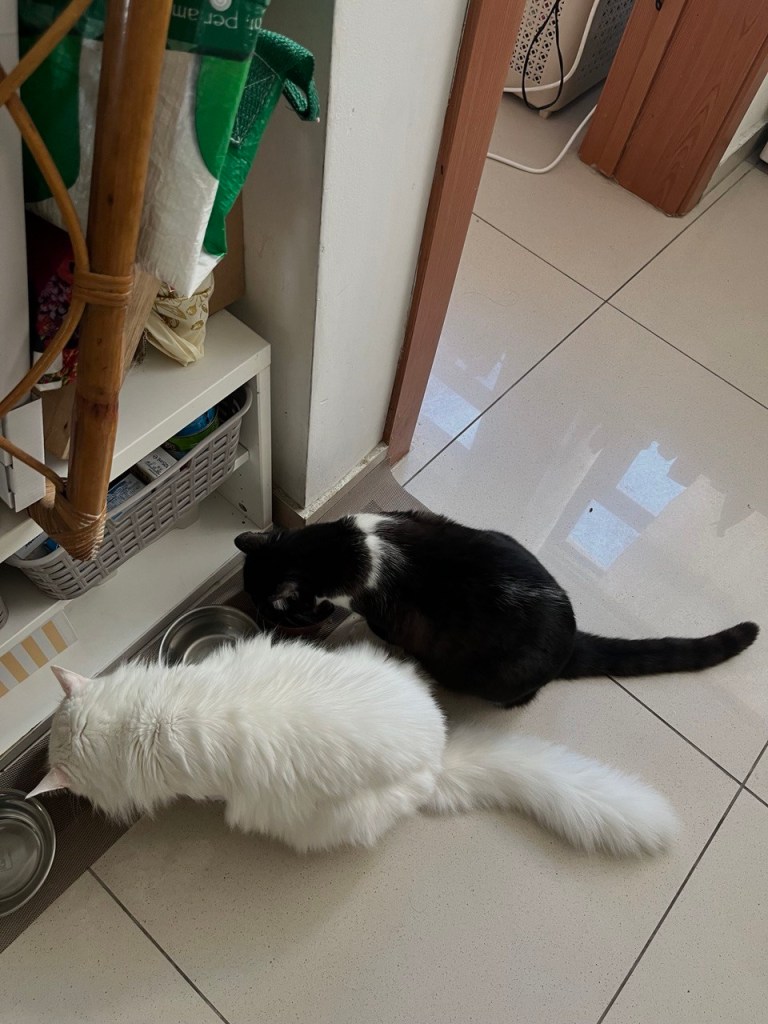
    As I stand in her kitchen, watching the cats eat, I can’t help but feel like our life in Malta is something out of a movie. After all, I can’t recall a time when I was this involved with a neighbour. 

  • Masumi

    For two hours, we’re in Japan. 

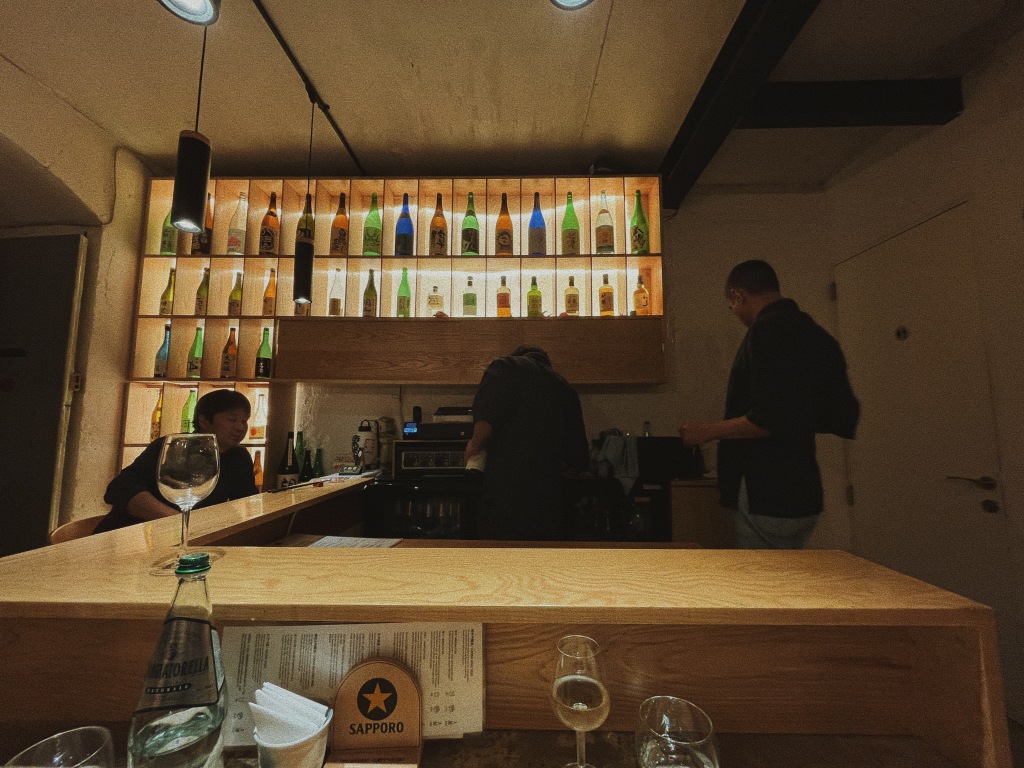
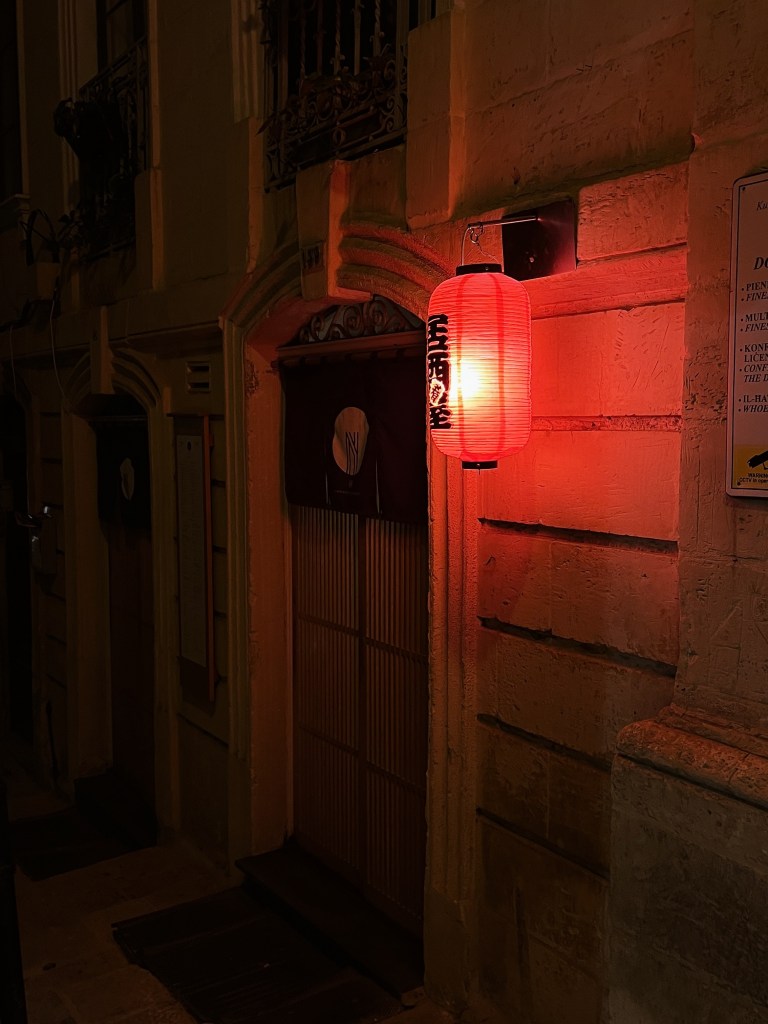
    An upscale izakaya, our greatest find yet in this food desert. Small menu, extensive sake selection. That’s how you know it’s good. Specials board changes every month. I had their berry chocolate ganache once and inhaled it in seconds. 

    Through the side door, a Japanese woman adorned in the intricate folds of a kimono glides into the restaurant, capturing the immediate attention of fellow patrons. With a polite request for a table for one, the Japanese server gestures towards a counter table.

    She takes a seat with a posture that echoes discipline and grace and surprises the air with an order of Asahi beer in English. The Japanese server nods in understanding and promptly reaches for a menu, accompanied by an introduction to the Specials board also in English.

    After a brief survey of the room, she returns her attention to the menu. A subtle smile plays on her features as she reaches a decision. In the midst of her contemplation, a Serbian server, stationed behind the counter, asks if she is ready to order.

    She admits the overwhelming choices before her. With a thoughtful suggestion, he recommends starting with the agedashi tofu. Grateful for the guidance, she agrees, and he vanishes into the kitchen. 

    Meanwhile, the Japanese server uncorks an Asahi beer bottle, pouring its golden contents into a waiting glass. He places it before her on the counter and tells her to enjoy. She indulges in a sip, a subtle nod of satisfaction punctuating the moment. Lowering her glass, her gaze catches the Japanese server.

    “Are you Japanese?”

    “Yes, are you Japanese?”

    “Yes, yes, I am also Japanese.”

    “Ahh, Konichiwa!”

    “Konichiwa!”

    Pleased with the discovery, she starts to chat with him in indistinguishable Japanese. As the conversation ebbs into a momentary silence, she leans back, hands placed neatly on her lap, patiently awaiting the promise of a warm culinary delight. 

  • Couch to 5k

    I have always thought that running was inherently uncomfortable and that anyone who chose to do it had a high threshold for pain.

    In the past, I would be so sore after a run, I needed a week to recover. By the time I was ready to head out again, my enthusiasm had waned just from anticipating the pain.

    My relationship with running continued to fluctuate. I replaced running with hiking and was regularly at it until I left for Europe. The logistics of looking for housing along with acclimatising to my new life put an end to any form of physical activity.

    When I finally settled in Malta and had some semblance of normalcy, I was mainly hiding indoors doing calisthenics. Summer was brutal and although the longer days were a nice welcome from dreary Ireland, the heat was relentless. Coupled with the humidity, I didn’t feel like moving an iota of muscle.

    By the time September rolled around, the temperatures became a lot more tolerable. I was ready to come out of hibernation. I decided then that completing a 5k would be my winter project. With encouragement from a friend who was a veteran runner, I signed up for a race with 20 days to train.

    This time I was going to do things differently. I consulted the same friend for some advice and she recommended I use a couch-to-5k app. After a bit of research, I went with Nike Run Club.

    On the second day of September, I went for what would be my first run in 2 years.

    That run took me 20 minutes and only as far as 2 kilometres. That run was also deliberately slower than I have ever ran since lockdown but it was also the first time I finished a run feeling like I could go for another run.

    Game-changer.

    With the guided runs on the app, I discovered the right way of running. Up until then, I hadn’t considered form, posture, breath, or pacing. It was a whole new world.

    But of these elements, pacing had the biggest affect on me. It is everything. Pacing is what will make or break a run. Set off too fast and the run can quickly turn into a slog. As I have learned, slow runs, runs that allow you to talk without struggle is what motivates a runner (at least in the beginning) to keep showing up at the starting line.

    Diligently following the beginner guides, I often found myself finishing a run excited for the next one. I wasn’t sore to the point of being unable to move the next day and whatever knee-pain I had was also quickly rectified with a quick search on YouTube about form adjustment.

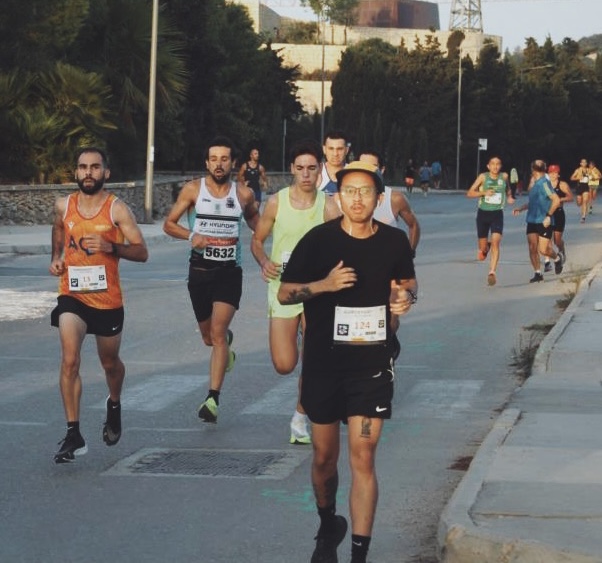
    It’s been two months now since I first started running and in that time, I have completed three 5k(s), two of which were races. My current personal record stands at 34 minutes.

    It was a misconception on my part to think that running is innate and that it was something people got better at the more they did it. And if they didn’t – as in my case – then it was just a matter of incompatibility. I forget we inhabit a world rich in knowledge and tapping into them can make all the difference.

  • The First Half Of 2023

    These events occurred between January and June 2023 and are not in chronological order. The reflections shared here are adapted from my journal.

    1. After two rounds of interviews, I got accepted for an internship. I enjoyed the work but the pay was pitiful. Guess it’s better than a non-paying internship or at least that’s what I told myself to feel better about my labour.

    2. I was admitted into hospital for ten days with vestibular neuritis. That was a scary time in my life. At the risk of sounding dramatic, I really thought I was going to die. But when you lose your ability to walk and can no longer control the movements in your eye (I didn’t even know that was possible) it truly feels like your time might be up.

    3. The experience of being in a hospital in Malta couldn’t have gone more smoothly. Barring the food of course but then again when have hospitals been known for their culinary flair? I spent a lot of time observing the Maltese people, how they communicated and interacted with one another. Along the way, I managed to pick up a few words/phrases that came in handy for extracting a laugh from the nurses.

    4. To our relief, my ten-day stay in the hospital, along with an MRI scan, came at absolutely no cost courtesy of the Maltese government and my being married to my wonderful EU passport-wielding wife. Never thought a marriage certificate would serve to be the second-most important document in our possession.

    5. My first trip to Geneva, Switzerland was quite an adventure. I flew there solo and navigated buses myself to meet Nine. Travelled with my walking stick and it allowed me to bypass the long airport queues. I couldn’t help to feel a little conflicted considering I was not as wobbly as just a couple months previously.

    6. Emma, Nine’s friend from Scotland, came to visit and we went to see some old rocks together.

    7. Then, Deens came to visit, and we enjoyed a wonderful week together, reconnecting, laughing, and simply sitting side by side, mindlessly crafting our IG stories and feeds. I had missed her immensely. Her visit couldn’t have come at a more perfect time. I was grappling with overwhelming loneliness after the move, and having someone who knows me, who has witnessed my growth over the years, and who feels like a living piece of home, was exactly what my weary soul needed.

    8. It took another two months before I could wean myself off the walking stick. My vision had mostly returned to normal. The lag or drag I’d felt for months was gradually disappearing.

    9. I lay low at home, waiting for summer to end. I did appreciate the longer daylight hours, but I’m not a fan of the heat. We bought an outdoor fan for our indoor home. It was noisier than I liked it to be but it saved us from turning the AC on all day. I spent my days practising calisthenics, reading, watching films, and hanging out with some new friends we’d made from showing up at migrant meet-ups and other events.

    10. In the last six months, I’ve attended a handful of protests which included a march advocating for refugees.

    11. Couldn’t find a good book shop in Malta but there is an art house cinema so I’m counting my blessings.
  • Anybody

    Dance scenes are my new favourite thing in movies. Saw this one in Return to Seoul and I haven’t been able to stop thinking about it. There’s an intriguing quality to the way she dances, almost as if she’s preparing herself for a battle. But who or what is she fighting against? Is it herself? The world?

    I know the type. Like Freddie, they often come across as distant, impulsive yet desperately yearning for love, acceptance, and connection. Although when offered, it is often times rejected. In the film, Freddie repeatedly flees whenever someone tries to get close, instead choosing to pursue those who won’t reciprocate or may even be harmful to her well-being. It’s a defence mechanism many of us are familiar with—a belief that we can shield ourselves from pain by building walls or hurting others before they have a chance to hurt us. As the story unfolds, we witness these behavioural patterns playing out and it never ends well.

    What struck me about this scene was how the dance reflected the character’s true essence, motivations, and the emotional turmoil within. From the mechanical movements to the lyrics, “I never needed anybody,” echoing the conflicting voices in her head. She knows on one hand, her yearning for connection, yet it is also difficult to shake off the belief that it’s better to be alone.

    The scene was so entrancing that I didn’t even notice the cuts on the first watch, assuming it was all shot in one take. Also unrelated but worth mentioning, the track used was an original film soundtrack and it is electric.

  • Why Malta?

    When I was still living in Donegal, I paid 50 euros to see a GP hoping he could write me a prescription for some meds I required. I had all the necessary medical documents from home to verify that I needed these life-saving meds but Ireland’s healthcare decided they won’t recognise these documents. I have been on these meds for the past 6 years with no trouble. What I was seeking was continued care which I was glad to pay out of pocket, no cost to the public. But this just wasn’t an option for a migrant in Ireland.

    In order for them to dispense the meds, I’d have to start from the back of the queue in their system which could mean months, possibly years, before I would even be seen by a specialist. That was out of the question. I do not want and cannot live without these meds.

    I appealed to the GP and he told me he would “study” my case to see if he could help me skip the queue. That was 4 months ago and I still haven’t heard back.

    __
    A question I get a lot now that I’ve left Ireland is “Why Malta?”

    Just a few months ago, I would not have thought about this place. What even is a Malta? My knowledge of this country stretches only as far as their Eurovision entries and that too is recent. In 2021, I was pleasantly surprised by Destiny and her song Je Me Casse, which she performed with great energy and powerful conviction.

    I hadn’t thought of Malta since but when we were trying to figure out where in Europe had housing and access to the kind of healthcare I needed, Malta emerged and was apparently positive on these fronts plus they spoke English. I was so hard done by Ireland, I could not help but feel sceptical about my prospects. If a progressive country like Ireland could not resolve my medical needs then there was no hope elsewhere, let alone Malta – a Mediterranean island nation that you had to pinch zoom a few times to find on a map.

    Our options were limited and we were running out of time. My next dose would be in a few months and we didn’t want to risk waiting any longer for housing or meds to become available. At this point – three months into our time in Ireland – we’d only had one viewing and it was for a tiny one-bedroom flat, two and a half hours away from Dublin. We had immediately agreed to it but then were ghosted by the landlady.

    We thought Malta couldn’t possibly be worse than Ireland so after double-checking with various local grassroots organisations, we bought our tickets and jumped on a plane. Within a week, we secured housing at a central location with fantastic local and Asian food stores, bars and walking distance to the sea.

    The true test arrived when a local friend invited me to go with him to see his family’s GP to ask for the prescription I needed. Again, I had very low expectations. I was prepared to receive some feigned sympathies from the doctor and then be sent on my way with no outcome other than a ludicrously exorbitant bill.

    Instead, she pulled out her prescription pad and started scribbling before I could even finish appealing my case. She took a quick glance at the letters and documents from home and told me not to worry. For the first time, I actually believed it was going to be okay. And all of this for 20 euros that I didn’t even have to pay for because my friend was going to claim it from his insurance. Amazing.

    __
    So, why Malta?

    Because in Malta, doctors take a more collaborative approach with their patients. They trust their patients, especially ones that are already looking for continued care. They don’t discriminate, not against me and not against where my medical docs are from.

    Ireland’s healthcare bureaucracy is not reflective of the people’s values. Despite how strongly I feel about Ireland, her people and how much I loved living just over the border from Derry, it was not reciprocated. I can’t stay in a place that ignores my pleas and would rather see me suffer than provide a simple piece of paper to say I deserve to live.

    The Irish are by far some of the loveliest people I’ve met outside of home, it’s a damn shame that I couldn’t call it my own. Malta may be a second choice but here I have a shot at a dignified life.

  • Unscrew The Nut

    Or Post-Episode Notes #3

    Couple of episodes ago on the Al & Al Podcast, we talked about the difficulty of navigating male friendships. I admitted to having trouble connecting with other men. If you listened to the episode, you can tell I was still untangling the knots, dissecting the possible causes but couldn’t quite nail down any solid conclusions.

    Then I saw an interview on Twitter with Jane Fonda and something clicked.

    1. “Women’s friendships are very different than men’s friendships.”
      She says that men sit side by side, watching sports or cars or women, whereas women sit facing each other, eye to eye, and they ask for help when they’re in trouble.

      The first thing that came to mind was how much male friendships operate on this level of utility or pleasure. It is either based on what one can do for the other or based on an enjoyment of a shared activity, usually in the pursuit of fleeting pleasures or emotions. In both of these friendships, it is a means to an end. The other person is not being valued because of who they are.

      Aristotle describes the greatest form of friendship as the friendship of virtue. These are the people you like for themselves, the people whose values you hope will rub off on you so as to inspire you to become a better person.

      It occurred to me that it is not that I have trouble connecting with other men, but it is hard to find men who make that cut of ‘virtuous’. Like I said in the podcast, most guys I’ve met only want to talk about stuff – stuff they owned, stuff they’ve seen, stuff they’ve done.

      Though I know it may not always be the case and we should be wary of sweeping statements like these, it did make me think about the women friends in my life and how they are generally more open in asking for and offering help, support, and encouragement, as well as talking about matters of the heart.
    2. Her favourite ex-husband believes you can’t make friends after 60.
      Studies have shown that men generally get lonelier the older they get, and this is not for want of friends to hang out with, but people to whom they can actually air feelings of vulnerability. Masculine norms coupled with the prevalence of homophobia teach men that vulnerability is weakness. Men are not taught to invest deeply in interdependent relationships with other men. And so this fear of judgement can make it hard for those who are struggling to share their challenges.

      Jane Fonda’s suggestion and I think everyone should model after is…
    3. Be intentional with your friendships.
      What she means is that you need to pursue people you want to be friends with.

      There is a scene in this Swedish film, Together (2000), where an older guy confesses to purposely unscrewing his newly fixed pipe just so he could get the plumber to come again and they could talk some more. After a couple of shared beverages, he opens up about how lonely he has been feeling and expresses that it is better to eat porridge together than a pork cutlet alone.

      It is obvious from the way the plumber shifts in his seat that he is uncomfortable talking about such emotional matters. But as the viewer has been shown, the plumber himself is also struggling with loneliness and despair, after his wife’s departure due to his addiction with alcohol and the physical abuse that followed it.

      Eventually though, the plumber comes around and opens up about how much he misses his family. And the older guy ends up encouraging him to make amends and see his wife to ask for her forgiveness.

      This entire exchange is a powerful demonstration of what healthy male friendships can achieve.

      Mostly I related to the older guy who messed with his plumbing on purpose just so he could make a friend. This is not to say that all of us should start breaking things at home to make friends, but sometimes we do need to put in the effort if we want quality friendships. Friendships that don’t only make you a less lonely person, but that challenge you to be better.

      I myself have done several versions of this – I once joined a gym to make friends with a guy I thought had a great sense of humour and who I knew I would get along with. Then there was another time when a colleague with whom I’d never worked before asked if anyone from the company would join him in attending an exhibition abroad. I was always impressed with his work and he seemed like a sound guy so I said yes.

      These friendships are still solid and flourishing after all these years. I have learned from them how to be kinder, warmer, adaptable, and more confident. And they in turn have found our conversations to be liberating and free from judgement.

    It is a cycle. And in hindsight, I believe it was growing up with community, places like the church, where I met people who were great models of vulnerability that encouraged me to open up. It has been 10 years since I left, but the values have stayed with me.

    Outside the church, it is trickier to emotionally connect with men, especially men who were only taught to model stoic behaviours and knew no other modes of expressing themselves. But like Jane Fonda, I am optimistic that if I continue to say or show my intentions of wanting to be their friend, they will stick around.

  • Malta: First Impressions

    Weather. The mediterranean climate is a welcome change for someone whose been cursing the cold since I arrived in Ireland. At 18°, people are bundled up in puffer jackets, scarfs and hats. Ireland has conditioned me well. I only needed two layers. Too cold for the Maltese, warm enough for flies.

    People. It’s probably unfair to compare to the Irish. This is not to say Maltese people aren’t friendly. I’ve had the opportunity of meeting some lovely and helpful locals while I was there. But the friendliness of Irish people are unparalleled. Nothing like I’ve ever experienced in all my travels.

    Architecture. Nothing but beige as far as the eye can see. Primarily because their buildings and pavements are constructed with limestone. In some of the older buildings, there are wooden window frames which screened the window space completely known as the Maltese balcony. They are usually painted in bright primary colours. Malta also has several fascinating fortresses and megalithic temples. We had the pleasure of attending a gig in one of these old forts. It was magical.

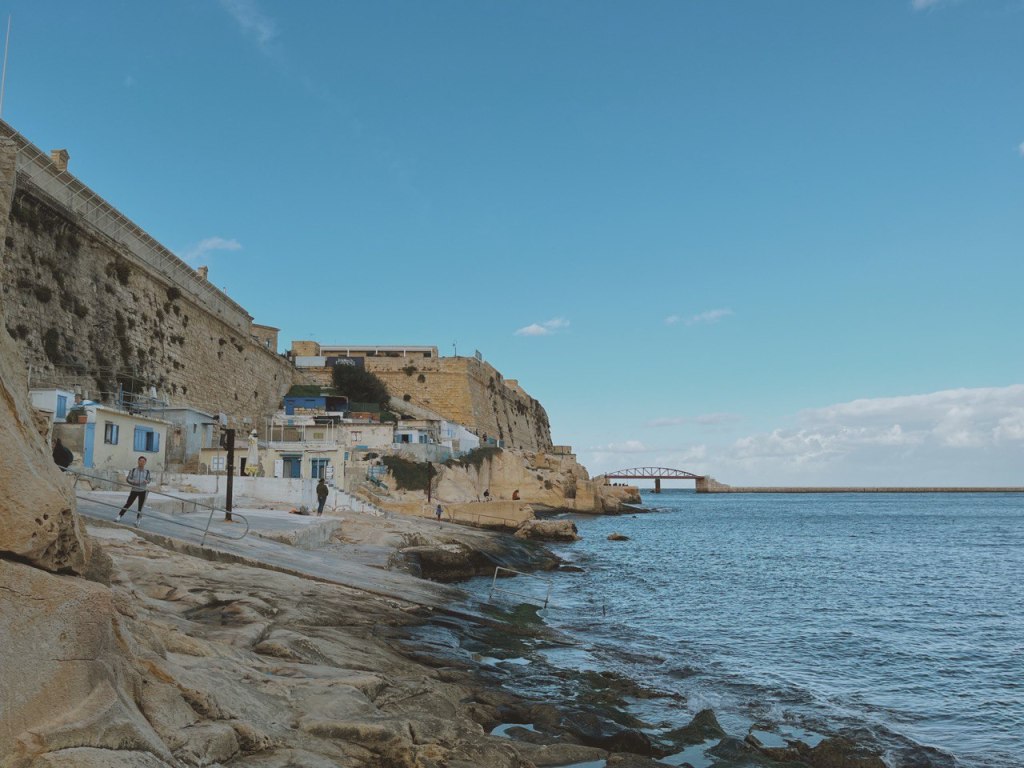
    Landscape. I can’t believe I’m saying this, I truly have come a long way but sadly there are no mountains or rivers in Malta. It’s completely forest free. The beige is eye-pleasing to look at but after a while, you do begin yearning for some greenery. Even so there are postcard-perfect coastal cliffs and plenty of clear blue waters but hiking for me is still preferable to swimming in the ocean any day.

    Transport. There are cars everywhere. Streets are narrow, a result of limited space on the island so there are no special lanes for buses or cyclists. Speaking of cyclists, I asked a local if cycling was a thing and they told me in the most matter of fact way that I will certainly die if I tried. Drivers in Malta are notorious for fast and reckless driving. Although the congestion is nowhere as bad as Kuala Lumpur, drivers it seems are twice as impatient. There were a lot of gesturing and sudden breaking in the cabs that I took. Speaking of cabs, they have a Grab/Uber equivalent called Bolt and they are always only 1-2mins away. It’s mostly walkable if you’re in a central location. If not, there are buses but I’ve been spoiled by the convenience of Bolt so I can’t confirm their reliability.

    Food. Probably not a priority for most but Malta has an array of Japanese restaurants. Back home, we get Japanese takeout at least twice a week. Since moving to Ireland, apart from Dublin, that routine has largely come to a halt. Malta does have a decent variety of food. The best things I ate were a seafood pasta from an Italian restaurant and a vegan hotdog from a random cafe in the capital. We also had a really impressive meal, specifically the Caribbean Tataki dish at a South American restaurant for Nine’s birthday.

    Language. When I first heard spoken Maltese, I was blown away at the complexity. If you’re not paying close attention, you’d think you’re hearing Italian but to the trained ear, it is more like Arabic with interspersions of English, French and Italian sounding words. It’s a beautiful language, possibly quite tricky to learn. But definitely not as impossible as Irish.